Tamdeen Youth Foundation and SIF Co-Host International Panel at COP31 in Antalya on Climate Adaptation in Fragile Settings
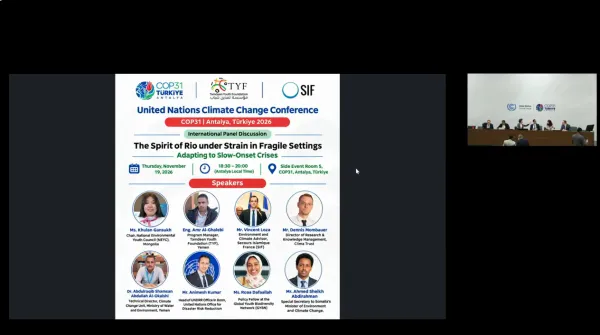
On Thursday, November 19, 2026, Tamdeen Youth Foundation (TYF), in partnership with Secours Islamique France (SIF), organized an international panel discussion titled "The Spirit of Rio under Strain in Fragile Settings: Adapting to Slow-Onset Crises" in Side Event Room 5 on the sidelines of the UN Climate Change Conference (COP31) in Antalya, Turkey.
The session brought together government officials, international experts, and civil society representatives from Yemen, Sudan, Somalia, Mongolia, the UN Office for Disaster Risk Reduction (UNDRR), and Clima Trust to examine the growing interconnection between climate change, drought, desertification, biodiversity loss, fragility, and conflict, as well as ways to build effective synergies across the three Rio Conventions.
TYF Highlights Yemen’s Reality and Local Resilience Solutions
During the panel, Eng. Amr Al-Ghalbi, Program Manager at Tamdeen Youth Foundation (TYF), delivered a keynote intervention outlining the escalating impacts of drought and desertification on rural communities in Yemen. He explained that because most families rely on rain-fed agriculture and livestock, failing rains result in the complete loss of crops and livelihoods. He also pointed to the collapse of historic highland agricultural terraces, sand encroachment onto coastal farmlands, and increasingly deep wells—forcing families to sell their livestock, reduce food consumption, pull their children out of school, and ultimately flee their homes.
Al-Ghalbi highlighted the disproportionate burden on women and girls, who spend three to five hours daily fetching water. In response, he showcased successful community resilience models implemented by TYF, including supporting 12 women-led water associations to empower women in natural resource decision-making, and training youth to install and manage solar energy systems—equipping them with market-driven skills that provide sustainable livelihoods and protect them from recruitment or forced migration.
Concluding his remarks, Al-Ghalbi stressed the need to move from working in separate sectors to joint action centered on community needs, calling on humanitarian, development, and climate actors to share information, coordinate plans, and involve local NGOs and communities from the outset.
Alarming Figures and a Severe Financing Gap
Opening the session, moderator Ms. Valentina Origoni, Advocacy Director at Secours Islamique France (SIF), presented alarming global indicators, noting that 42 out of 48 countries (approximately 87–88%) that experienced new conflict-related internal displacement in 2025 also experienced disaster-related displacement. She emphasized that 16 of the 25 most climate-vulnerable countries in the world—including Yemen, Somalia, and Sudan—are fragile and conflict-affected, yet they receive only a quarter of the climate adaptation finance they need.
Official and International Interventions on Finance and Early Warning
For his part, Dr. Abdulraqeeb Shamsan Abdullah Al-Akaishi, Technical Director of the Climate Change Unit at Yemen’s Ministry of Water and Environment, stated that Yemen faces acute water scarcity, with just 65 cubic meters per capita annually compared to the global scarcity threshold of 500 cubic meters. He noted that a lack of data and weak institutional coordination are major barriers to accessing major climate funds, calling for fast-tracked climate finance—which currently takes three to five years—and facilitated technology transfer, such as wastewater treatment systems.
The panel also featured key contributions from international experts and representatives:
- Mr. Vincent Loza (Environment and Climate Advisor, SIF): Stressed that adaptation must be integrated, conflict-sensitive, and rights-based. He warned that technologies like solar pumping can accelerate groundwater depletion if not paired with community governance, and underscored the importance of community-based early warning systems for anticipatory action.
- Mr. Animesh Kumar (Head of Office, UNDRR Bonn): Called for a shift from a financing model based on "bankability" to one based on "vulnerability," integrating conflict sensitivity into risk data and strengthening local trust and preparedness.
- Mr. Dennis Mombauer (Director of Research and Knowledge Management, Clima Trust): Proposed establishing a financial "allocation floor" for fragile contexts and factoring in the "peace dividend" when evaluating project viability, citing Panama’s example of unifying its climate and environmental commitments.
- Ms. Khulan Gansukh (Chair, National Environmental Youth Council – NEYC, Mongolia): Called for easier access to funding for local organizations implementing integrated climate, land, and biodiversity projects, and for greater inclusion of women and pastoralist communities in decision-making.
- Ms. Roa Dafalla (Policy Fellow, Global Youth Biodiversity Network – GYBN): Highlighted the interplay between armed conflict and climate change in Sudan, urging joint plans, indicators, and financing across the three Rio Conventions that reach civil society directly.
- Mr. Ahmed Sheikh Abdulrahman (Special Secretary to the Minister of Environment and Climate Change, Federal Government of Somalia): Revealed that Somalia’s forest cover declined from 13.2% in 1990 to 7.7% in 2025, emphasizing the need to move from policy-level coordination to integrated implementation at the community level.
Key Recommendations
The session concluded with several core recommendations to carry forward to upcoming COPs, most notably: adopting joint national plans and indicators across the three Rio Conventions; providing fast-tracked, flexible, multi-year climate and environmental finance with direct access for local organizations; recognizing local governance and anticipatory action as legitimate adaptation outcomes; and placing people and biodiversity at the center of environmental policies.
This event forms part of Tamdeen Youth Foundation’s (TYF) ongoing efforts in international forums to advocate for Yemeni communities affected by climate change and humanitarian crises, and to mobilize global support toward sustainable solutions that strengthen resilience and peacebuilding.